RA-L 2026
Semantic-GSL: Semantically Guided Gas Source Localization With Vision-Language Models
Using visual semantic context to guide the search for a gas source.
RA-L 2026 · 연구실 게재 목록의 저널 제목은 “Semantic-GSL: Integrating visual semantic context into information-theoretic search for gas source localization”입니다. 아래 요약과 Figure는 공개된 IROS 2025 워크숍 버전을 기준으로 합니다. / Summary and figures below describe the publicly available workshop version.
한국어 요약
어디에서 가스가 나올 가능성이 높을까?
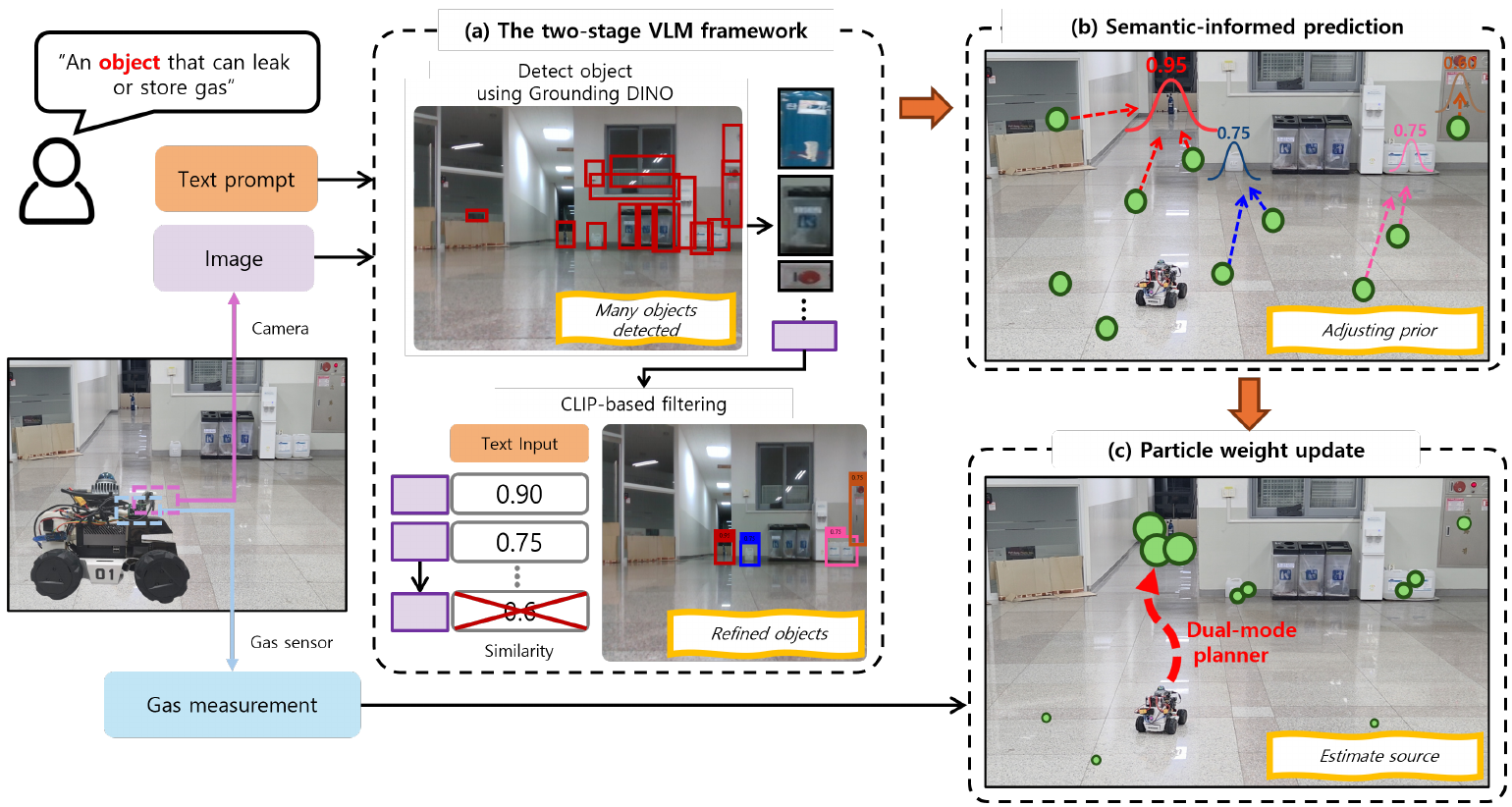
가스 농도만으로 누출원을 찾으면 복잡한 기류와 측정 잡음 때문에 탐색이 길어질 수 있습니다. Semantic-GSL은 “가스를 저장하거나 누출할 수 있는 물체”라는 의미 단서를 이용해 가능성 높은 영역에 탐색을 집중합니다.
의미 정보를 확률 추정에 결합
Grounding DINO가 영상과 문장으로 후보 물체를 찾고, CLIP이 관련성을 평가해 후보를 정제합니다. Semantic-informed particle filter는 이 정보를 활용해 입자를 재배치하고 가스 측정으로 가중치를 갱신합니다. 이후 정보 기반 탐색기가 다음 이동 위치를 선택합니다.
공개 워크숍 버전의 결과
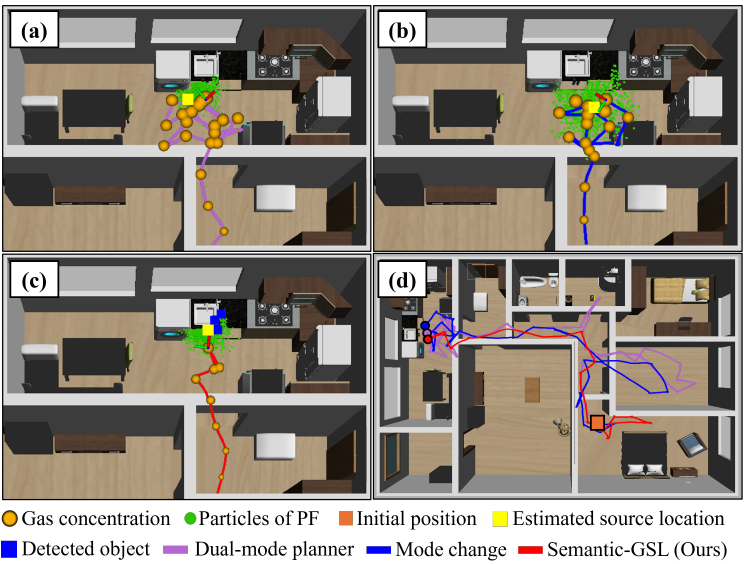
두 실내 환경의 시뮬레이션에서 탐색 효율과 추정 정확도가 개선됩니다. 환경 1에서 추정 오차는 기본 dual-mode planner의 2.47 m에서 0.94 m로 줄었습니다. 잘못된 의미 단서는 탐색을 오히려 방해할 수 있어 후보 정제가 중요합니다. 이 수치는 공개 워크숍 실험의 결과입니다.
English summary
Semantic-GSL uses scene meaning to guide gas source estimation. Grounding DINO proposes objects from a descriptive prompt, and CLIP filters them by semantic relevance. A semantic-informed particle filter shifts hypotheses toward plausible source objects, then updates their weights with gas measurements. An information-driven planner selects the next sensing location.
The public workshop paper evaluates two simulated indoor environments. In environment 1, estimation error decreases from 2.47 m for the dual-mode baseline to 0.94 m. Reliable semantic filtering matters: misleading detections can bias the search. These results describe the workshop version, rather than an independently verified evaluation of the later journal article.
Inside the paper · 주요 Figure
Publication: FAIR Lab journal list, RA-L 2026 (in press). Summary and original figures: public IROS 2025 workshop paper. 그림을 클릭하면 원본 크기로 볼 수 있습니다.