RESEARCH DIRECTION / 01
Geometric Perception
Safe and scalable 3D perception across sensing modalities.
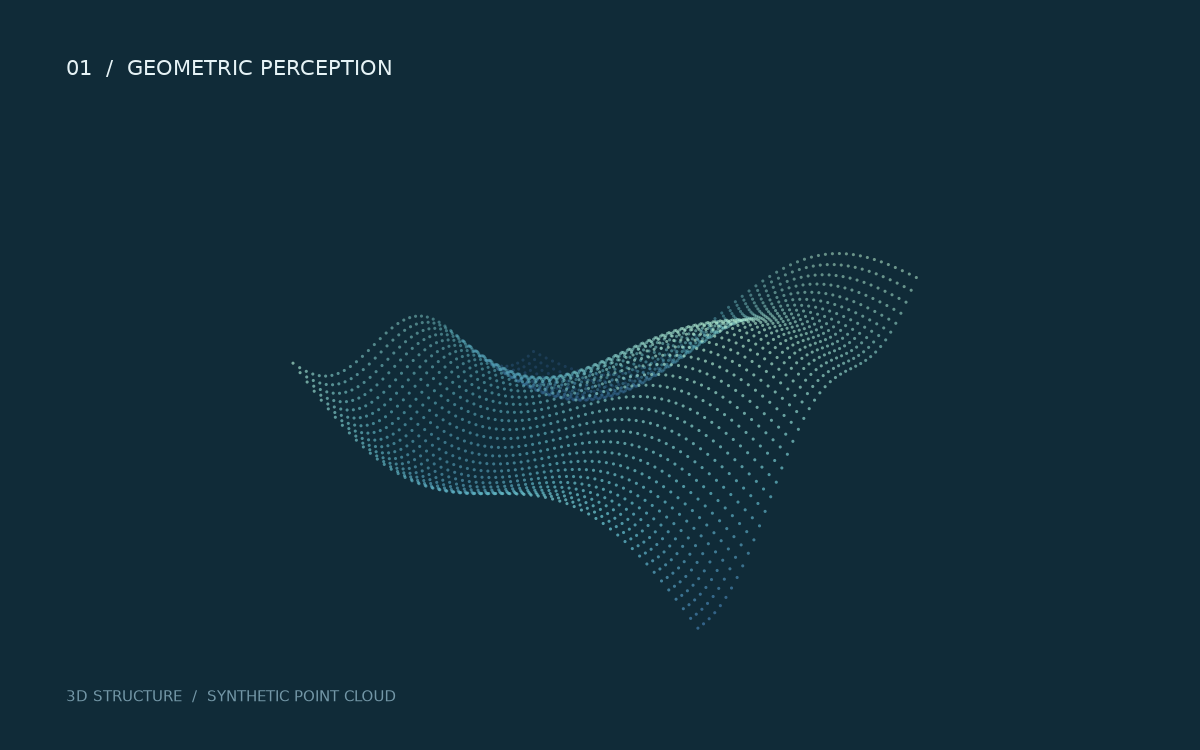
Conceptual illustration: a sampled 3D surface, colored by height. Not an experimental result.
Seeing structure beyond the sensor
I am interested in building safe and scalable 3D geometric perception systems for robotics. A central question is how different geometric perception algorithms can operate in a sensor-agnostic manner, enabling robust performance across heterogeneous sensing modalities.
Sensors describe the world in different ways. My interest lies in the geometric structure behind those observations: how it can be represented, related across measurements, and used reliably by a robot.
Questions I want to explore
- What geometric information can be shared across different sensing modalities?
- How can a perception system remain reliable when measurements are noisy or incomplete?
- How can geometric reasoning scale while retaining the structure needed for robust estimation?
From perception to robust estimation
Reliable geometry also depends on how we handle observations that do not agree. My Graduated Non-Convexity notes examine this connection through robust estimation and optimization.